Kikuo Saito: 2025

$25.00

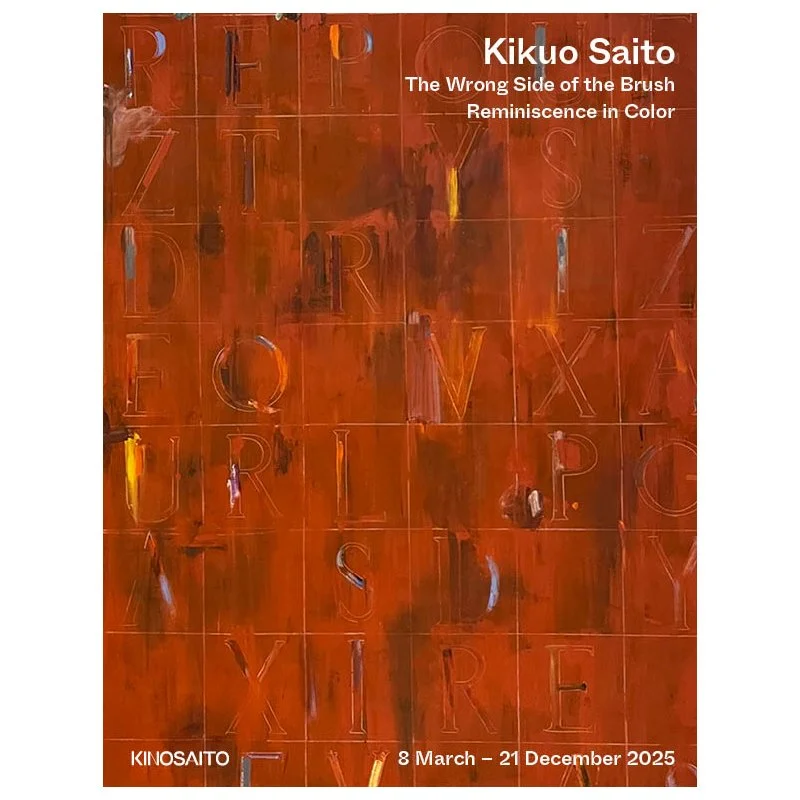
Catalogue for exhibition taking place at KinoSaito | 8 March – 21 December 2025

The Wrong Side of the Brush curated by Kikuo Saito Studio. The Wrong Side of the Brush brings together six paintings, five of them made between 1977 and 1978, and a single one — the blue one, Blue Ladder — made in 1987. The medium is acrylic on canvas kept raw, without gesso, a technique favored by Saito that puts his work into direct conversation with that of Helen Frankenthaler, who also often preferred to paint onto — to paint atop — an unprepared ground. These raw canvas patches or pools enframed by playful color became a hallmark of Saito’s acrylic style of the period, but this intimate grouping of canvases is unified by a more subtle procedure, namely the use of the brush’s handle, “the wrong side of the brush,” to drag lines — squiggly lines, slashing lines — through the background color. The result suggests the fundamentally abstract nature of craquelure, a network of rips, tears, and seams abraded and coming loose — lines along which light might enter the painting and illuminate it from within. 

Reminiscence in Color curated by Mikiko Ino Saito. Kikuo Saito forged his own path in the Color Field movement, on a mission to find colors that had never before existed. Curated by Mikiko Ino Saito, wife of the late artist, this selection of works explores his bold and unique use of colors and gestures to evoke moods, feelings, and sensations.

Catalogue for exhibition taking place at KinoSaito | 8 March – 21 December 2025

The Wrong Side of the Brush curated by Kikuo Saito Studio. The Wrong Side of the Brush brings together six paintings, five of them made between 1977 and 1978, and a single one — the blue one, Blue Ladder — made in 1987. The medium is acrylic on canvas kept raw, without gesso, a technique favored by Saito that puts his work into direct conversation with that of Helen Frankenthaler, who also often preferred to paint onto — to paint atop — an unprepared ground. These raw canvas patches or pools enframed by playful color became a hallmark of Saito’s acrylic style of the period, but this intimate grouping of canvases is unified by a more subtle procedure, namely the use of the brush’s handle, “the wrong side of the brush,” to drag lines — squiggly lines, slashing lines — through the background color. The result suggests the fundamentally abstract nature of craquelure, a network of rips, tears, and seams abraded and coming loose — lines along which light might enter the painting and illuminate it from within. 

Reminiscence in Color curated by Mikiko Ino Saito. Kikuo Saito forged his own path in the Color Field movement, on a mission to find colors that had never before existed. Curated by Mikiko Ino Saito, wife of the late artist, this selection of works explores his bold and unique use of colors and gestures to evoke moods, feelings, and sensations.

Kikuo Saito was born in Tokyo in 1939 and at age twenty-two apprenticed under an established Japanese master painter while also absorbing the many new art movements emerging in Japan, Europe and the U.S. After a brief time working in lighting and stage design in Japan, he moved to New York in 1966, when radical thinking and new modes of expression in both painting and performance had introduced an era of bold experimentation in the arts. Kikuo explored the free, expressive pouring and dragging of paint across canvas then the purview of Color Field painters but soon found a vocabulary of his own in compositions of gestural brushstrokes, cryptic signs, letter forms, loose geometric shapes, and washes of color, at times bold and intense and, at other times, veil-like and mysterious.

In those early New York years, he found a home at La MaMa Experimental Theatre Club where he designed sets, costumes, lighting and props and developed theater productions that blended qualities of the Japanese avant-garde with his own spare aesthetic. He went on to work with noted theater directors Robert Wilson and Jerome Robbins on both national and international productions. He took painting classes at the Art Students League, where he would later teach, and encountered the work of many of the era’s innovators. Soon he was working in the studios of such notable painters as Larry Poons, Kenneth Noland and Helen Frankenthaler. For many years, Saito worked back and forth between theater and painting, the graceful movement, concise forms, and lighting qualities of the former greatly influencing the latter, and vice versa. Eventually, he turned solely to his studio practice where he honed his sophisticated compositions full of motifs and signs both real and imaginary, and his bold, unexpected use of color.

Through his teaching and in his studio, Saito supported and mentored a wide array of creative thinkers, many of whom today continue their practice in painting, writing, architecture and design.