

15 Sep. 2026
News Release
Joan Mitchell Foundation Releases Report On Artist Legacy Stewardship & Online Legacy Field Map
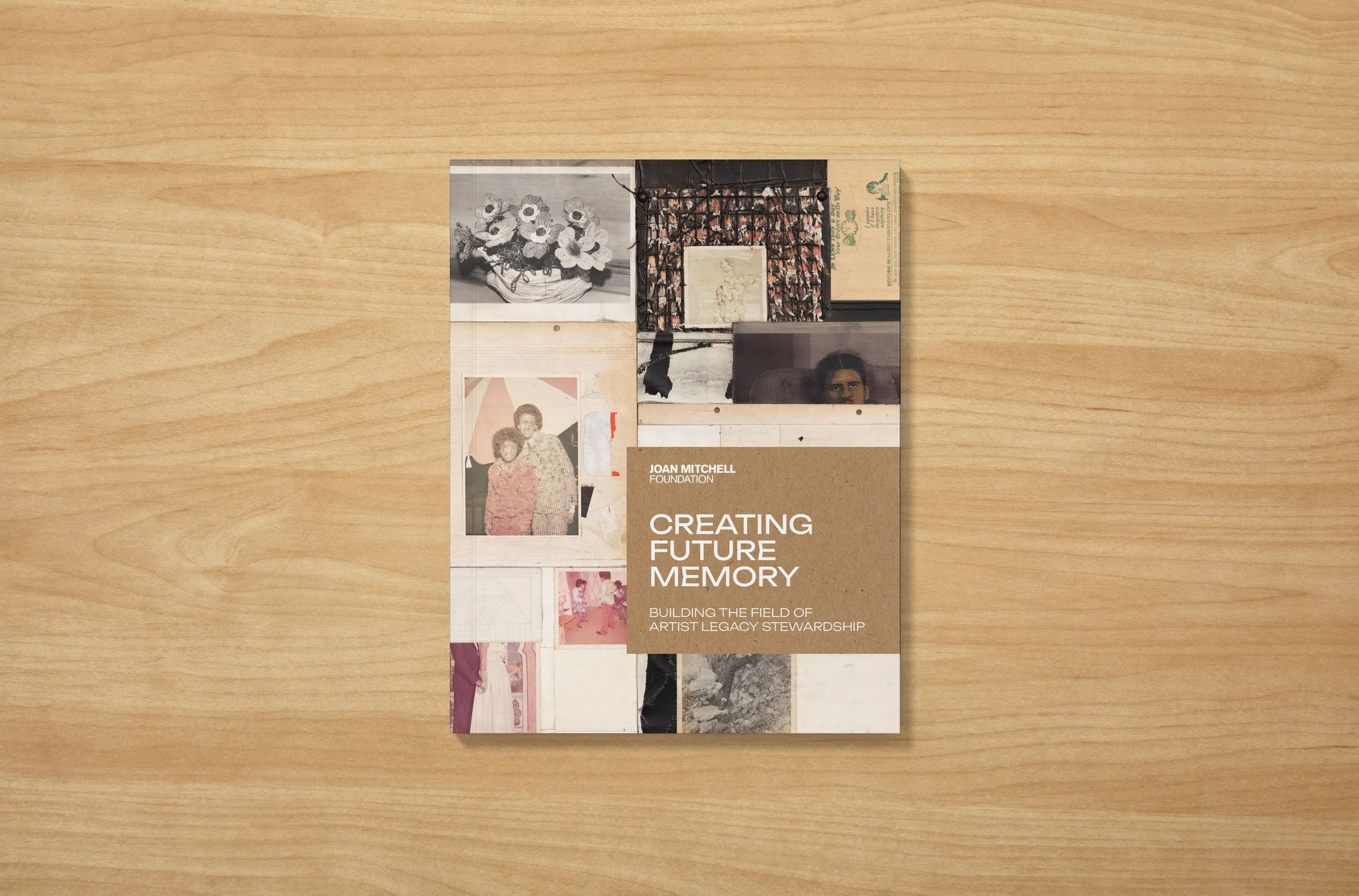
NEW YORK, NY – What happens to an artist’s work, archives, and ideas when they are gone? Who makes the decisions that drive who and what gets to be remembered? What stories and perspectives are at risk of being lost in times of accelerated cultural erasure? These questions are at the heart of a new report from the Joan Mitchell Foundation: Creating Future Memory: Building the Field of Artist Legacy Stewardship, available as a free PDF download via the Foundation’s website. Alongside this publication, the Foundation is also launching an online Legacy Field Map—a crowd-sourced directory designed to support connection, knowledge-sharing, and community among those working to preserve and celebrate artists’ lives and work across the country.
“With the release of the Creating Future Memory report and companion Legacy Field Map, we aim to share the current state of artist legacy work in the US while making the case for deeper, more equitable investment in this work, within the arts and beyond,” said Christa Blatchford, Executive Director, Joan Mitchell Foundation. “The stories and data that we have compiled after years of field work, research, and conversations clearly demonstrate how central legacy stewardship is to artists, communities, institutions, and our shared cultural record. Without intentional legacy planning and sustained attention to the preservation and contextualization of a broad range of artists’ work, we risk losing entire ways of seeing, knowing, and relating to the world and to one another.”
The Foundation’s commitment to artist legacy work is rooted in its experience as stewards of Joan Mitchell’s own legacy, and builds on more than 15 years of providing resources through its Creating a Living Legacy (CALL) initiative. Drawing on this past work and ongoing research, the Creating Future Memory report is grounded in the voices and big ideas from a field-wide convening of the same name that the Foundation hosted in May 2025 at BRIC in Brooklyn, with support from the Mellon Foundation. The event brought together 145 individuals: artists, family members working on their loved ones’ legacies, legacy workers, representatives from artist-endowed foundations, archivists, conservators, curators, grantmakers, and representatives of art institutions, the market, and governmental agencies.
“What we heard from participants at the convening was both inspiring and sobering: across the country, individuals, collectives, and organizations are doing extraordinary work to preserve artistic legacies—yet these efforts remain largely disconnected from one another and chronically under-resourced,” said Solana Chehtman, Director of Artist Programs, Joan Mitchell Foundation. “Alongside this dedication, we continue to hear urgent accounts of loss: archives discarded or damaged, artworks destroyed, artists forgotten. And perhaps most persistently, we hear from artists’ family members and other legacy workers that they are overwhelmed from taking on the enormity of this work with a lack of adequate knowledge, funding, connections, or infrastructural support. In the current political climate, as cultural erasure accelerates, the need for collective action has never been more pressing.”
Creating Future Memory Report Summary
Written by Solana Chehtman and Sharon Mizota, and edited by Christa Blatchford and Jenny Gill, Creating Future Memory: Building the Field of Artist Legacy Stewardship is organized in two parts, the first of which makes a case for why artist legacy work matters, explores who is involved in this broad ecosystem, and outlines what legacy work looks like.
The Foundation argues that by safeguarding and contextualizing creative works and histories, legacy stewardship provides cultural continuity, especially for artists and communities underrepresented in mainstream institutions. Often considered an endeavor undertaken by an individual artist or their estate, legacy stewardship encompasses a wide range of activities and involves people from various areas of expertise. It is an important cultural and economic ecosystem that requires greater attention and investment from organizations and institutions so that the burden does not fall fully on the artists and their supporters.
As detailed in the report, legacy stewardship encompasses the care of artworks, maintenance of analog and digital archives, creation of oral histories, and stewardship of creative spaces—along with all the accompanying logistical, organizational, technological, and financial concerns. Artists and estate executors must decide how to frame the narrative, what to keep, what to distribute or seek institutional placement for, and what to discard. What’s important to note is that artist legacies for individuals and collectives are as diverse as their practices, and cannot be prescribed a shape or a narrative. It is essential that artists’ agency is centered throughout the planning process.
The second half of the report outlines key challenges facing the artist legacy stewardship ecosystem, many of which stem from structural inequities in the broader cultural landscape. Through the Creating Future Memory convening and its other research, the Foundation has identified three main types of challenges in artist legacy stewardship: 1) access to knowledge, 2) funding and resources, and 3) coordination and collaboration. The publication unpacks these concerns while highlighting promising strategies emerging in the field.
Key Voices from Creating Future Memory
Mikiko Ino, President, Director, and Chairperson of KINOSAITO, described preserving her late husband Kikuo Saito’s legacy: “Kikuo always said there are two deaths: the first is physical, and the second is when nobody talks about you. I decided to never give him the second death.”
Christa Blatchford, Executive Director, Joan Mitchell Foundation, reflected: “I came into this work thinking about the individual and the objects, and the artist Jaune Quick-to-See Smith reminded me that this is about community. She would say, again and again, ‘Preserving my legacy is about preserving American history.’”
Artist and curator Amalia Mesa-Bains asserted in her keynote presentation: “They’re running with a big eraser right behind us. Remembering is a defiant act.”
Thelma Golden, The Studio Museum in Harlem’s Ford Foundation Director and Chief Curator, commented on the importance of trust-building and sensitivity on the part of legacy workers: “I try to enter conversations not as a voice of legality but as one of care.”
Artist Juan Sánchez: “I’ve seen artwork taken out of studios and thrown into a dumpster and it’s very painful to witness. Every one of us is vulnerable.”
Glenn Phillips, Getty Research Institute Chief Curator, commented on the urgency of legacy planning: “Artists, your children don’t know what to do. Make a will. There’s nothing more nightmarish than dealing with an estate when there’s no will.”
Yayoi Shionoiri, Vice President of External Affairs and General Counsel at Powerhouse Arts, noted: “Each artist’s estate deserves a bespoke set of strategies. It’s not one size fits all… for example, not every artist’s estate needs to be incorporated into a foundation.”
Artist Teresita Fernández stated: “I think we need to reframe the idea of who archives are for, and perhaps invert this idea that artists need help to preserve their legacies. Instead, we should highlight that archives are for everybody. Because they shape future ideas of history. Every single person in this room has a job that stems from the work of artists, so we are also talking about a larger ecosystem of documentation and public archiving that goes far beyond any one individual.”
At the Convening, Daisy Murray Holman, daughter of artist Elizabeth Murray, Trustee of her estate, and Executive Director of the Artists’ Legacy Foundation, asked that every family member of an artist stand up so that she could identify them, and made a plea to other children of artists: “If you’d like to be in touch, just to talk about what it feels like to be in this position, I’d like to continue that conversation.” She has since been working on a website for “Artists’ Kids” and connecting to exchange information specific to their vantage point.
The Legacy Field Map
With the need for more connection and information sharing in mind, alongside the Creating Future Memory report the Joan Mitchell Foundation launched an online Legacy Field Map to identify nonprofit organizations throughout the country moving legacy work forward in different capacities, many of which are proposing innovative and interesting models that others can learn from. Under the principle of shared responsibility, organizations can submit their information directly to the Foundation and suggest other organizations to be added. As the Legacy Field Map grows organically over time, the goal is to provide visibility for legacy organizations, as well as facilitate connection and information exchange between organizations across the country.
About the Joan Mitchell Foundation
The Joan Mitchell Foundation cultivates the study and appreciation of artist Joan Mitchell’s life and work, while fulfilling her wish to provide resources and opportunities for visual artists. Through its work, the Foundation affirms and amplifies artists’ essential contributions to society.
As stewards of Joan Mitchell’s legacy, the Foundation manages a collection of Mitchell’s artwork and archives containing her personal papers, photographs, and sketchbooks. Staff are dedicated to assisting researchers, sharing information, and fostering dialogue and scholarship on Mitchell’s life and work. The Foundation regularly partners with institutions to ensure that a wide and diverse audience has access to Mitchell’s artworks through exhibitions, educational activities, and public programming. The Foundation also administers copyright and reproduction requests related to Mitchell’s artwork, and supports the Joan Mitchell Catalogue Raisonné project, which is currently researching Mitchell’s paintings for a future publication.
Fulfilling Mitchell’s mandate to “aid and assist” living artists, over the past 33 years the Foundation has evolved a range of initiatives that have directly supported more than 1,350 visual artists at varying stages of their careers. The Joan Mitchell Fellowship gives unrestricted awards of $60,000 directly to 15 artists annually, with funds distributed over a five-year period alongside learning, peer engagement, and network-building opportunities. The New Orleans-based Joan Mitchell Center hosts residencies for national and local artists, complemented by professional development offerings, open studio events, and other public programs that encourage dialogue and exchange with the local community. The Creating a Living Legacy (CALL) initiative provides free and essential resources to help artists of all ages organize, document, and manage their artworks and careers. Together, these programs actively engage with working artists as they develop and expand their practices. For more information, visit joanmitchellfoundation.org.