

At the core of KinoSaito’s physical space, and its mission, is the theater. A 1500sf vaulted space, the theater is the site of original new works of theater and performance, as well works from Kikuo Saito’s theater oeuvre reimagined by contemporary performance groups. Regular programming includes dance performances, film screenings and concert recitals, along with performances, installations and new media work by artists in residence and visiting artists and companies.
THEATER GALLERY
Alison Knowles
Event Scores at KinoSaito, 2026
Performance scores by Alison Knowles
7 Mar. 2026 | 5:30pm
Performed by Hannah B Higgins and Clara Joy
11 Apr. 2026 | 3pm
Performed by Kia LaBeija and Taína Larot
23 May 2026 | 3pm
Performed by Holly Hobart and Hana Thompson
14 Jun. 2026 | 3pm
Performed by Holly Hobart and Hana Thompson
The House of Dust
The House of Dust is often considered one of the first computer-generated poems. Created by Alison Knowles in 1967, the work consists of the phrase “a house of” followed by a randomized sequence drawn from four lists: a material, a location or situation, a light source, and a group of inhabitants. Each line produces a new, imagined structure.
In 1968, Knowles translated one version of the poem into a sculpture in Chelsea turning the score into an open architectural space. Later reconstructed at CalArts, the house became a site for teaching, performance, and collaboration.
The project anticipated many developments in computer-assisted art. In 2023, a new version was realized as a 3D-printed building in Wiesbaden, Germany, in collaboration with tinybe.
#6 Shoes of Your Choice (March, 1963)
A member of the audience is invited to come forward to a microphone if one is available and describe a pair of shoes, the ones he is wearing or another pair. He is encouraged to tell where he got them, the size, color, why he likes them, etc.
Premiered April 6th, 1963 at the Old Gymnasium of Douglass College, New Brunswick, New Jersey.
#7 Piece for Any Number of Vocalists (December, 1962)
Each thinks beforehand of a song, and, on a signal from the conductor, sings it through.
Premiered May 11th, 1963 at Hardware Poets’ Theater, New York, during the Yamdays.
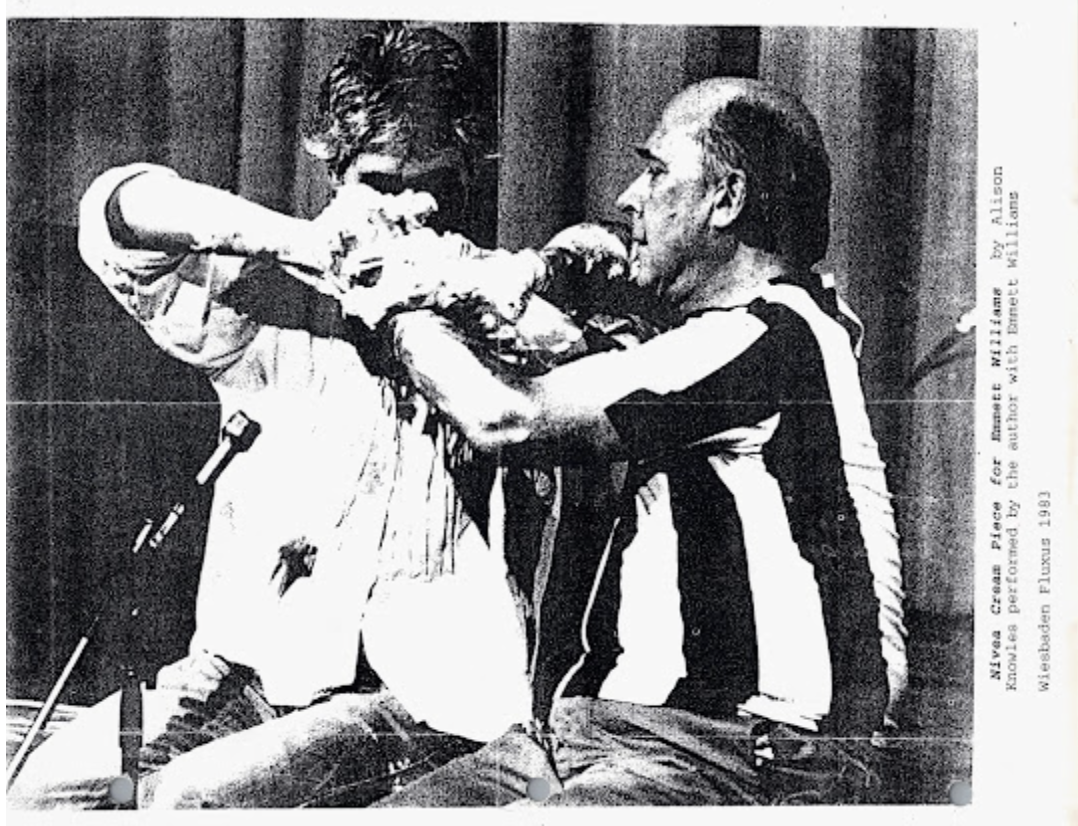
#3 Nivea Cream Piece (November, 1962) — for Oscar Williams
First performer comes on stage with a bottle of hand cream, labeled “Nivea Cream” if none is available. He pours the cream onto his hands, and massages them in front of the microphone. Other performers enter, one by one, and do the same thing. Then they join together in front of the microphone to make a mass of massaging hands. They leave in the reverse of the order they entered, on a signal from the first performer.
Premiered November 25th, 1962 at Alle Scenen Theater, Copenhagen, at Fluxus Festival.
#1 Shuffle (1961)
The performer or performers shuffle into the performance area and away from it, above, behind, around, or through the audience. They perform as a group or solo: but quietly.
Premiered August 1963 at National Association of Chemists and Perfumers in New York at the Advertisers’ Club.
The Fluxus movement is closely identified with the event score, a form of instructional performance. In Knowles’s hands, the event score frequently collapsed the boundaries between art and everyday action. The only woman on Fluxus’s inaugural European tour in 1962, Alison Knowles authored several event scores that became foundational to the movement. These works were first published in By Alison Knowles: A Great Bear Pamphlet (Something Else Press, 1965).
In 1967, with composer James Tenney, Knowles created The House of Dust using the programming language FORTRAN. Widely regarded as one of the first computer-generated poems, selections from this groundbreaking work will be performed as part of the exhibition at KinoSaito.
About Performers
Hannah B Higgins is a Professor in the School of Art and Art History at UIC (University of Illinois Chicago) and founder of the interdisciplinary BA program IDEAS. Her books include Fluxus Experience (University of California Press, 2002) and The Grid Book (MIT Press, 2009). With Douglas Kahn, she co-edited Mainframe Experimentalism: Early Computing and the Foundations of Digital Art (University of California Press, 2012). Her research explores experience as a sensory, social, and irreducible phenomenon. Recently, her Fluxus Seminar performed Grapefruit events as part of Yoko Ono: Music of the Mind at the Museum of Contemporary Art Chicago. Higgins is the daughter of Fluxus artists Dick Higgins and Alison Knowles.
Clara Joy is a New York–based songwriter and poet whose debut LP was released on the Shimmy-Disc label in 2025. Alongside her performance and recording projects, she organizes shows in support of New York City nightlife, arts, and music culture, working closely with local musicians and creative communities. She is the granddaughter of Fluxus artists Dick Higgins and Alison Knowles.
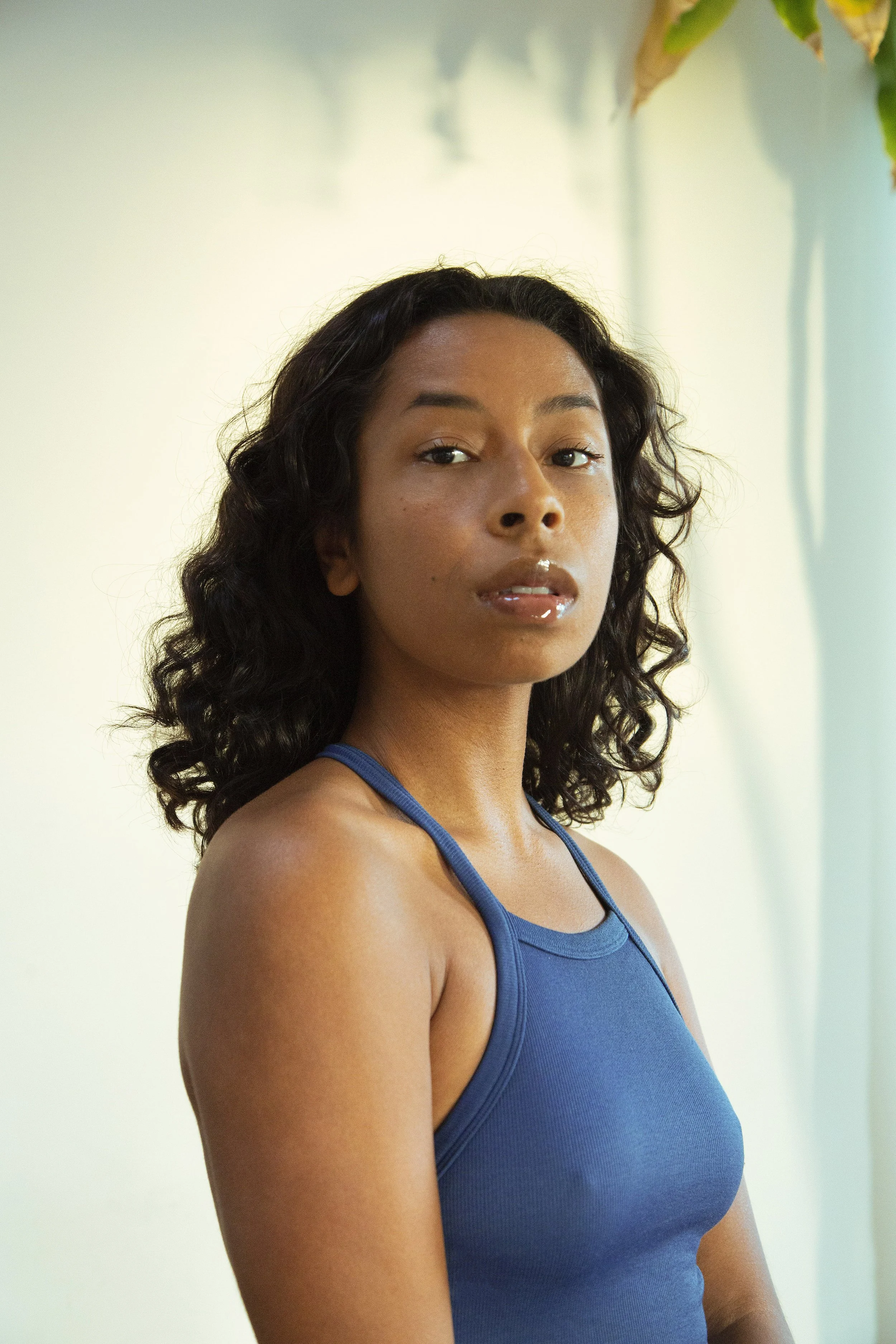
Kia LaBeija (b.1990) is an image maker and storyteller born and raised in the heart of New York City, Hell’s Kitchen. Her multidisciplinary practice includes photography, performance, collage, design, writing and film. She composes cinematic and theatrical autobiographical works by staging, re-imagining, sometimes documenting in real time, or all of the above. Her self-portraits embody memory and dream-like imagery to narrate complex stories at the intersections of womanhood, sexuality, belonging, and navigating the world as a woman living with HIV. She’s presented work at The Whitney Museum of American Art, The Brooklyn Museum, The Studio Museum in Harlem, The Museum of The City of New York, The Bronx Museum of the Arts, Los Angeles County Museum of Art, The International Center for Photography and the Performa ’19 Biennial. Highlighted commissions and collaborations include W Magazine, Harper’s Bazaar, Vogue, Apple, DAZED, OUT Magazine, Vice, and Triple Canopy. In 2022 she presented her first solo museum show prepare my heart at Fotografiska New York. Her highly regarded exhibition of original photographs, ephemera, objects and family images chronicles love, loss, and growing up HIV-positive in New York City. Heavily involved in New York’s Iconic House and Ballroom scene for a decade, Kia was a member of the Royal House of LaBeija where she served as the Overall Mother from 2017 to 2019. She played the title role of Dove in Band Pillar Point’s viral music video, and appeared as a Principal Dancer in the pilot episode of Ryan Murphy’s Ballroom Drama POSE. She is a 2019 Creative Capital Awardee alongside her partner Taína Larot. Kia is a graduate of the New School University.

Taína Larot is a multi-hyphenated creative, whose approach to visual art, movement, directing and facilitation surpasses the boundaries of what it means to be an artist. She uses personal style, design and her color dying technique dips as a means to communicate that she is a reflection of the world, and that the world is not black and white. Her intentionality in participating in the grey areas and practicing fluidity is a reminder that boxes can both separate and unite. With movement being her first language, it is the medium that provides her with the unique power and skill to bring people from all walks of life together. She is a profound delegator, a meticulous mind and an open heart.