
Alison Knowles: Secrets of Ordinary Things
Curated by Katrin Lewinsky
7 Mar. – 14 Jun. 2026
THEATER GALLERY
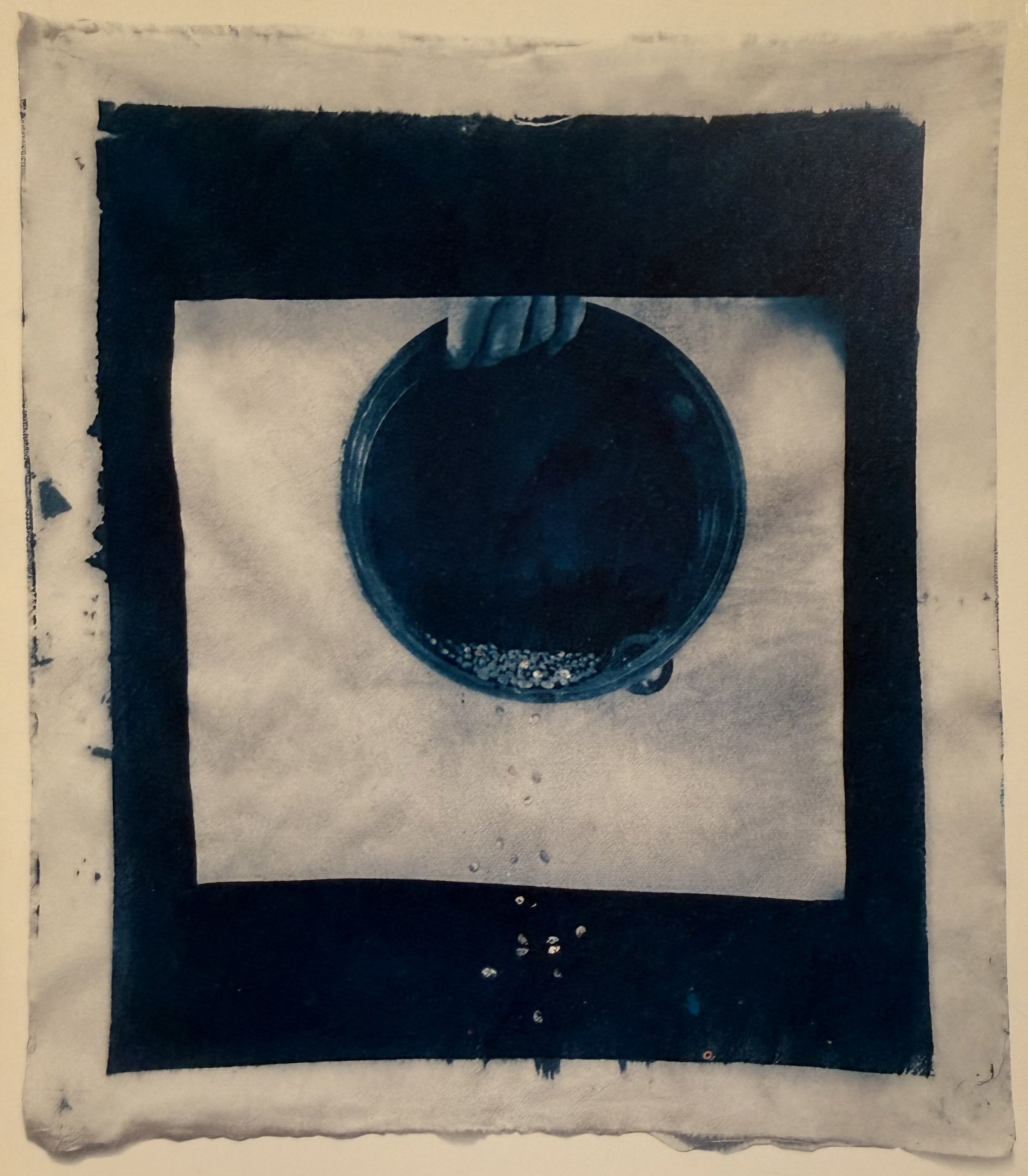
Alison Knowles, Tambourine with beans falling, 2002, Photo image and cyanotype on cloth, 20 1/2 x 23 1/2 in
Utilizing everyday materials, chance operations, and indeterminacy, Alison Knowles creates interactive performances, visual works, and installations that engage sound, objects, and lived experience. Her work invites viewers to become active participants, awakening personal perception through acts of listening, touching, and looking anew.
“The events I perform, the prints I have made and the environments I build are designed to put the spectator/performer in touch with him/herself and the real world. Since all feelings reside in the individual sensibility, I am interested in touching, awakening and activating certain of my own and your personal responses. Some of this happens through sound, some through the use of found objects in a given environment, some through the glorification of daily occurrences such as eating a sandwich or examining a button. I regard simple routine activities taken for granted, materials cast off as worthless, and unglorified products as worthy of all kinds of perusal. My environments and performances are collections of such things. Listen as if you had never heard it; look at it as if you had never seen it before. Investigate again what you already know.”
Celebration Red: Homage to Each Red Thing
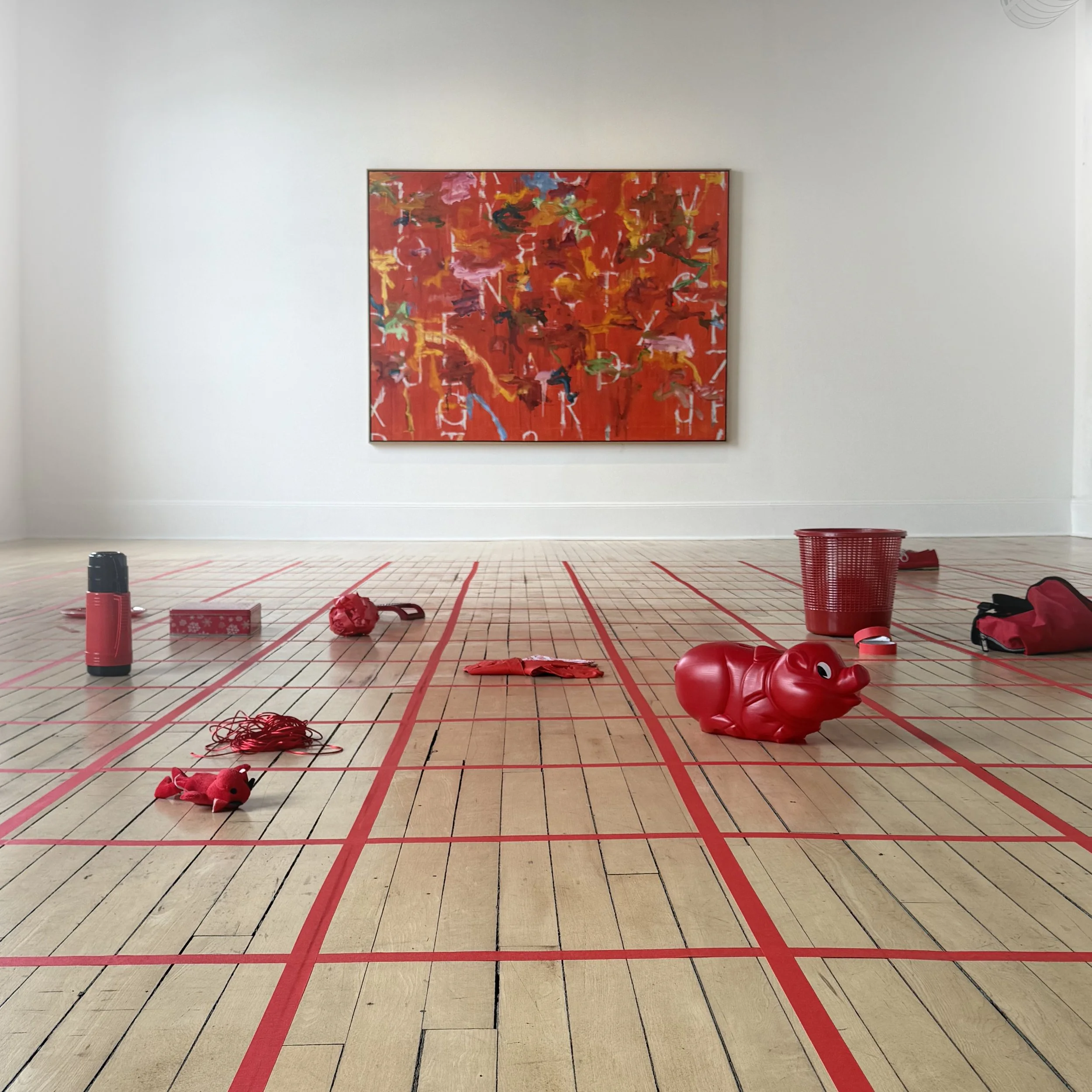
Installation view of Celebration Red at KinoSaito.
In Celebration Red, Alison Knowles extends her long-standing exploration of score, action, and everyday materials into the shared space of the gallery. Structured by a simple grid and activated through the placement of red objects, the work unfolds as a living composition, shaped by attention, chance, and communal action.
Rather than producing a fixed image, Celebration Red operates as an event that accumulates over time. Each gesture of exchange subtly alters the field, emphasizing community and the poetic potential of ordinary things. The floor functions simultaneously as score, event, and installation, an artwork activated by you, bringing attention to everyday objects and the shifting values we assign to them.
*Visitors are encouraged to engage with the art by bringing a red, hand-held object from their own environment to place in the grid.
PERFORMANCES
Alison Knowles
Event Scores at KinoSaito, 2026
Performance scores by Alison Knowles
Free | RSVP requested
7 Mar. 2026 | 5:30pm
Performed by Hannah B Higgins and Clara Joy
11 Apr. 2026 | 3pm
Performed by Kia LaBeija and Taína Larot
23 May 2026 | 3pm
The House of Dust
The House of Dust is often considered one of the first computer-generated poems. Created by Alison Knowles in 1967, the work consists of the phrase “a house of” followed by a randomized sequence drawn from four lists: a material, a location or situation, a light source, and a group of inhabitants. Each line produces a new, imagined structure.
In 1968, Knowles translated one version of the poem into a sculpture in Chelsea turning the score into an open architectural space. Later reconstructed at CalArts, the house became a site for teaching, performance, and collaboration.
The project anticipated many developments in computer-assisted art. In 2023, a new version was realized as a 3D-printed building in Wiesbaden, Germany, in collaboration with tinybe.
#6 Shoes of Your Choice (March, 1963)
A member of the audience is invited to come forward to a microphone if one is available and describe a pair of shoes, the ones he is wearing or another pair. He is encouraged to tell where he got them, the size, color, why he likes them, etc.
Premiered April 6th, 1963 at the Old Gymnasium of Douglass College, New Brunswick, New Jersey.
#7 Piece for Any Number of Vocalists (December, 1962)
Each thinks beforehand of a song, and, on a signal from the conductor, sings it through.
Premiered May 11th, 1963 at Hardware Poets’ Theater, New York, during the Yamdays.
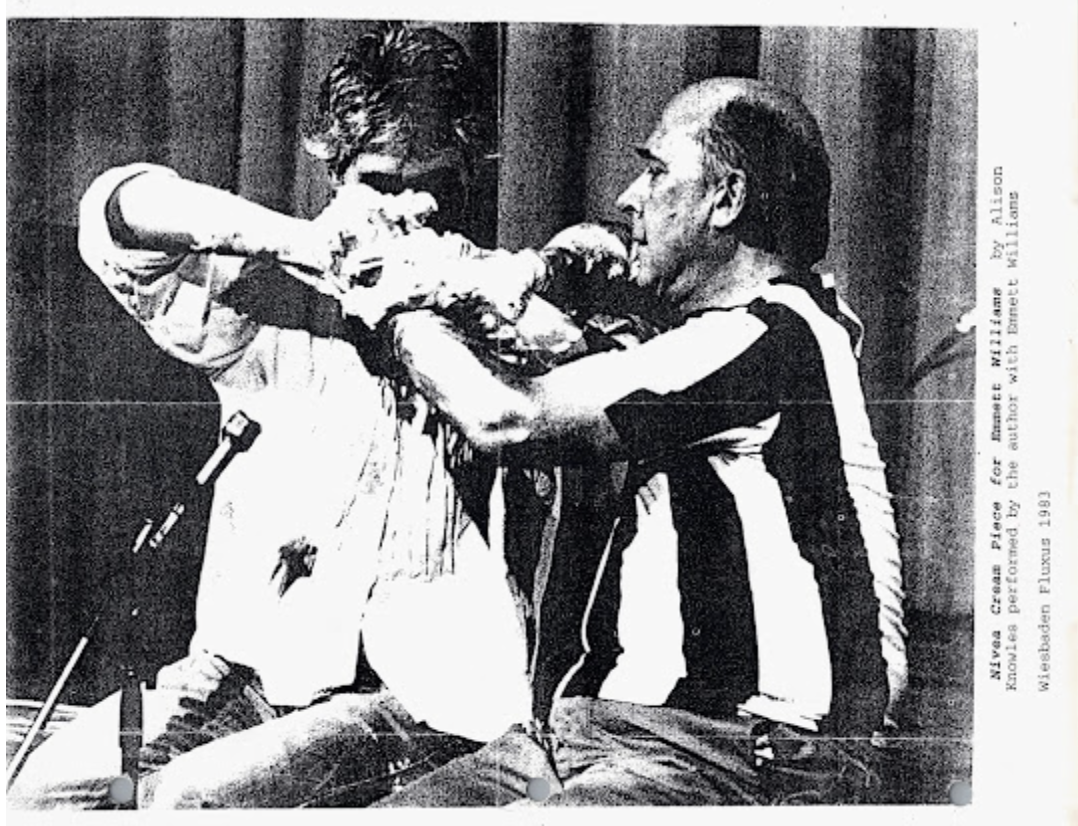
#3 Nivea Cream Piece (November, 1962) — for Oscar Williams
First performer comes on stage with a bottle of hand cream, labeled “Nivea Cream” if none is available. He pours the cream onto his hands, and massages them in front of the microphone. Other performers enter, one by one, and do the same thing. Then they join together in front of the microphone to make a mass of massaging hands. They leave in the reverse of the order they entered, on a signal from the first performer.
Premiered November 25th, 1962 at Alle Scenen Theater, Copenhagen, at Fluxus Festival.
#1 Shuffle (1961)
The performer or performers shuffle into the performance area and away from it, above, behind, around, or through the audience. They perform as a group or solo: but quietly.
Premiered August 1963 at National Association of Chemists and Perfumers in New York at the Advertisers’ Club.
The Fluxus movement is closely identified with the event score, a form of instructional performance. In Knowles’s hands, the event score frequently collapsed the boundaries between art and everyday action. The only woman on Fluxus’s inaugural European tour in 1962, Alison Knowles authored several event scores that became foundational to the movement. These works were first published in By Alison Knowles: A Great Bear Pamphlet (Something Else Press, 1965).
In 1967, with composer James Tenney, Knowles created The House of Dust using the programming language FORTRAN. Widely regarded as one of the first computer-generated poems, selections from this groundbreaking work will be performed as part of the exhibition at KinoSaito.
About Performers
Hannah B Higgins is a Professor in the School of Art and Art History at UIC (University of Illinois Chicago) and founder of the interdisciplinary BA program IDEAS. Her books include Fluxus Experience (University of California Press, 2002) and The Grid Book (MIT Press, 2009). With Douglas Kahn, she co-edited Mainframe Experimentalism: Early Computing and the Foundations of Digital Art (University of California Press, 2012). Her research explores experience as a sensory, social, and irreducible phenomenon. Recently, her Fluxus Seminar performed Grapefruit events as part of Yoko Ono: Music of the Mind at the Museum of Contemporary Art Chicago. Higgins is the daughter of Fluxus artists Dick Higgins and Alison Knowles.
Clara Joy is a New York–based songwriter and poet whose debut LP was released on the Shimmy-Disc label in 2025. Alongside her performance and recording projects, she organizes shows in support of New York City nightlife, arts, and music culture, working closely with local musicians and creative communities. She is the granddaughter of Fluxus artists Dick Higgins and Alison Knowles.
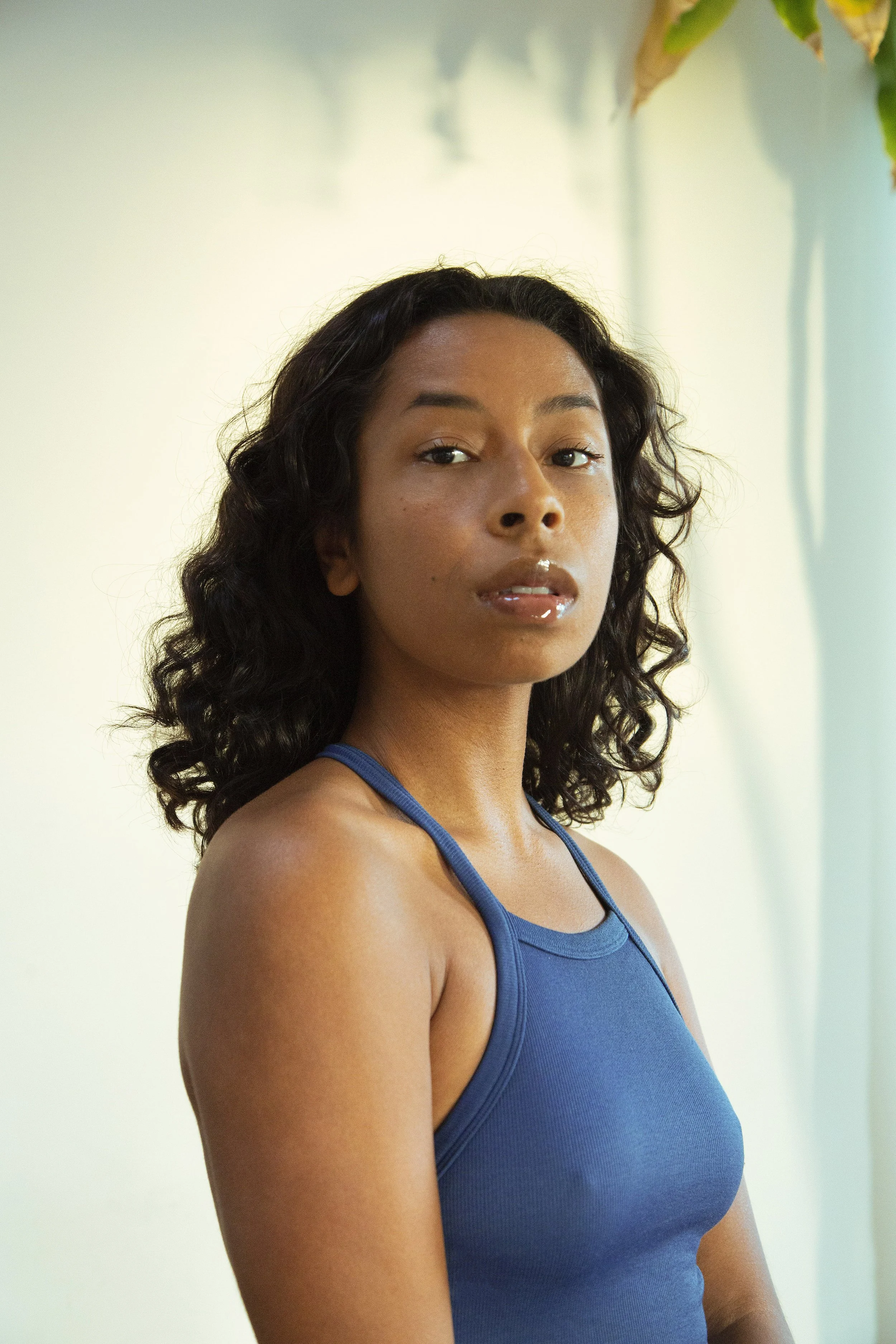
Kia LaBeija (b.1990) is an image maker and storyteller born and raised in the heart of New York City, Hell’s Kitchen. Her multidisciplinary practice includes photography, performance, collage, design, writing and film. She composes cinematic and theatrical autobiographical works by staging, re-imagining, sometimes documenting in real time, or all of the above. Her self-portraits embody memory and dream-like imagery to narrate complex stories at the intersections of womanhood, sexuality, belonging, and navigating the world as a woman living with HIV. She’s presented work at The Whitney Museum of American Art, The Brooklyn Museum, The Studio Museum in Harlem, The Museum of The City of New York, The Bronx Museum of the Arts, Los Angeles County Museum of Art, The International Center for Photography and the Performa ’19 Biennial. Highlighted commissions and collaborations include W Magazine, Harper’s Bazaar, Vogue, Apple, DAZED, OUT Magazine, Vice, and Triple Canopy. In 2022 she presented her first solo museum show prepare my heart at Fotografiska New York. Her highly regarded exhibition of original photographs, ephemera, objects and family images chronicles love, loss, and growing up HIV-positive in New York City. Heavily involved in New York’s Iconic House and Ballroom scene for a decade, Kia was a member of the Royal House of LaBeija where she served as the Overall Mother from 2017 to 2019. She played the title role of Dove in Band Pillar Point’s viral music video, and appeared as a Principal Dancer in the pilot episode of Ryan Murphy’s Ballroom Drama POSE. She is a 2019 Creative Capital Awardee alongside her partner Taína Larot. Kia is a graduate of the New School University.

Taína Larot is a multi-hyphenated creative, whose approach to visual art, movement, directing and facilitation surpasses the boundaries of what it means to be an artist. She uses personal style, design and her color dying technique dips as a means to communicate that she is a reflection of the world, and that the world is not black and white. Her intentionality in participating in the grey areas and practicing fluidity is a reminder that boxes can both separate and unite. With movement being her first language, it is the medium that provides her with the unique power and skill to bring people from all walks of life together. She is a profound delegator, a meticulous mind and an open heart.
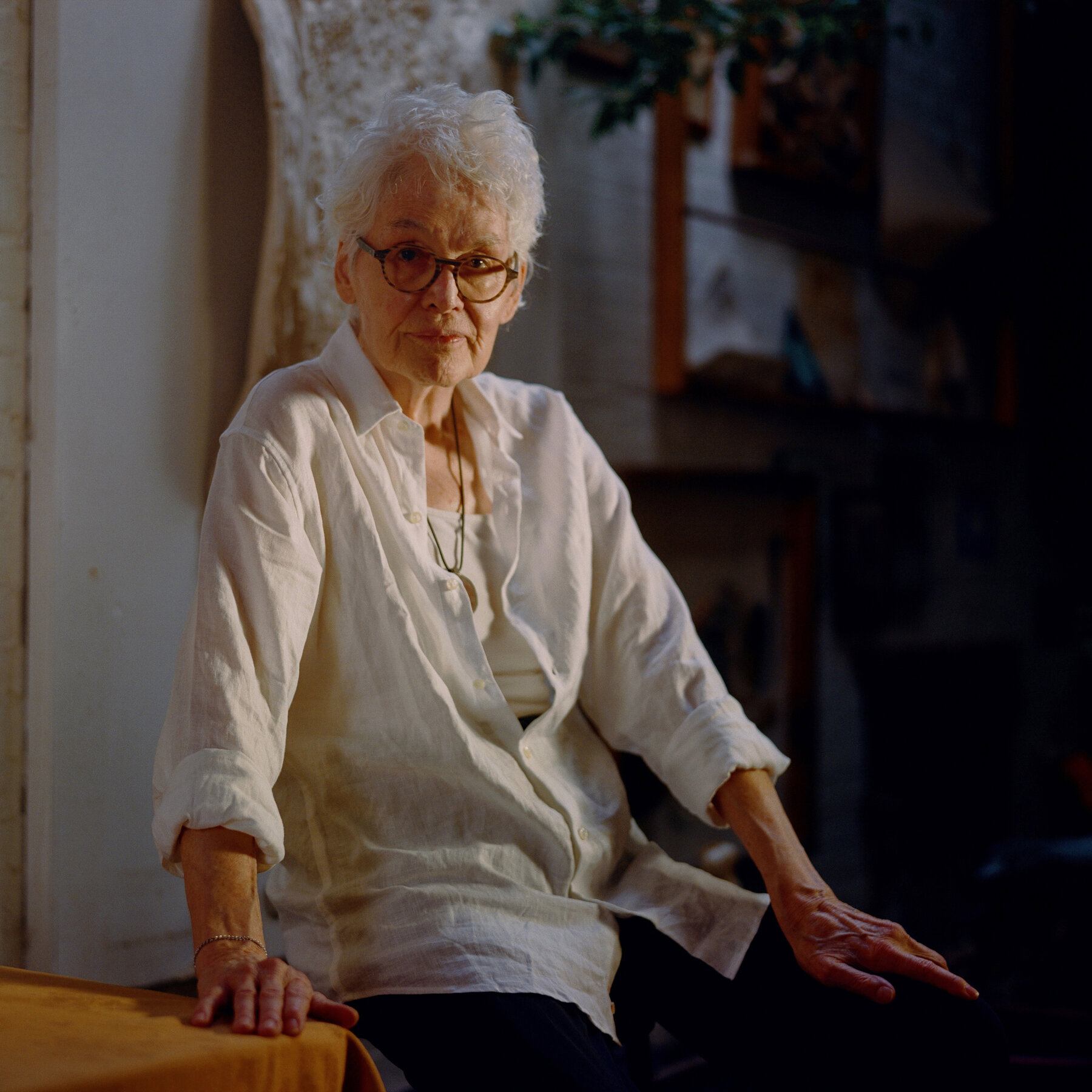
Photo by The New York Times
Alison Knowles (1933–2025)
“I think art should take us out of very good times or very bad. It’s a neutral resting place. It’s a place to take a breath. Art should relieve us and enliven us.”
It is with profound sadness and admiration that we commemorate the passing of Alison Knowles. A defining force in postwar experimental art, Knowles’s six-decade career has indelibly transformed the boundaries of art and life as we understand them. She was a founding member of the Fluxus group, whose ethos sought to disassemble traditional barriers between art forms, while rejecting the exclusivity of the art world in favor of art as an open and participatory experience accessible to all. She passed away peacefully at her home in New York City on October 29, 2025.
Knowles was born and raised in Scarsdale, New York in 1933, a small town north of the city. Knowles graduated with a degree in Fine Arts from Pratt Institute in 1956, where she studied under Richard Lindner and Adolph Gottlieb, as well as taking a summer course with Josef Albers at Syracuse University. During these years she also joined the New York Mycological Society, founded by composer John Cage, who became a close friend and creative influence. These early exchanges with peers like Cage and George Maciunas led to the formation of the Fluxus group. The first Fluxus performance took place in 1962 in Düsseldorf, Germany with an assembly of artists who would become central to the movement, including Knowles and Maciunas alongside Nam June Paik, Dieter Roth, Emmett Williams, Ben Patterson, Wolf Vostell, and Dick Higgins (whom she later married); inaugurating the group’s radical integration of chance and collective experimentation in live performance.
During this period, Knowles began working with Event Scores, a form originated by George Brecht, which she adapted and expanded to foreground audience participation, everyday gestures, and the performative potential of non-living materials. While Fluxus privileged collectivity, Knowles’s career embodies a generative paradox: an individual practice inseparable from collective participation and the dynamics of shared experience. Her first Event Score, Make a Salad (1962) presented a kind of concert between the rhythmic chopping of vegetables, musical accompaniment, and a collective gustatory experience, allowing participants to ingest and thus complete the performance. In total, Knowles produced well over a hundred Event Scores—The Identical Lunch (1967), Celebration Red (1962), Newspaper Music (1962–63), Shoes of Your Choice (1963), and Nivea Cream Piece (1962) among the most iconic. An early collection of her Event Scores appears in By Alison Knowles (1965) published by Something Else Press, which she co-founded with Dick Higgins in 1963 to champion intermedia art in book form and make avant-garde and performance-based art accessible to a broad public.
Knowles also broke ground in her experiments that took a collaborative approach with technology—most notably with The House of Dust, conceived in 1967, widely regarded as one of the first computer-generated poems. The work was created in partnership with composer James Tenney, who used an early IBM computer to program Knowles’s lines of poetry into continuous random variations. Each poem describes a set of four lists: houses made of various materials, in a certain location, with a particular light source, and different sets of inhabitants for the structure. In the decades since, numerous structures have been built based on one of the poem's quatrains—one of the best-known being on the grounds of CalArts, where Knowles taught (1970-72) in the Intermedia Program. Other experiments in data translation included her Onion Skin Song (1968), an early example of sonification in art in which she visually mapped the forms of onion skins into a score to be interpreted in live performance.
Knowles experimented often with the sculptural potential of the book form. Large-scale works like The Big Book (1967) and later The Boat Book (1979) envisioned walk-in sculptures that invited viewers to physically move through sculptural ‘pages’ anchored around a central ‘spine.’ Smaller objects such as the Tin Can Piece (1962) and The Bean Rolls (1963) reconceived ordinary tin cans as ‘books,’ containing written scrolls and other objects activated by the viewer’s handling of their contents. One part of the book, the page, informed her ongoing series of Loose Page sculptures begun in 1983. Early iterations, originally created in collaboration with master paper maker Coco Gordon, imagined interactive pages made for parts of the body, with the human spine taking the place of the book’s spine. Since the mid-'90s, Knowles also used paper to produce a series of sounding objects such as her Bean Turners, doubling as both pages and instruments. For these, she enclosed dried beans within stiffened layers of handmade paper. When picked up and inverted, the object produces resonant waves of sound, which she described as the sound of roaring waves and a high wind.
The use of negative space, which became a hallmark of Knowles’s oeuvre, also directly translated into her experiments with sun‑sensitive chemical processes. In many later works, she used light‑sensitive emulsion on fabric or paper to record the silhouetted forms of everyday objects placed directly onto the surface. Throughout her lifetime, Knowles repeatedly anticipated many of the concerns now foundational to contemporary art—from process- and material-based intermedia practices, relational aesthetics, and chance operations, to performance shaped by audience participation, sound art, and a reframing of everyday objects and domestic life as sites of cultural and political meaning. In a 2010 oral history interview for the Smithsonian Archives of American Art, Knowles’s adventurous spirit and creative generosity are distilled in her observation: “I often think the simplest gesture can carry a lifetime of meaning.”
Knowles’s expansive career is marked by major solo exhibitions including Alison Knowles at the Carnegie Museum of Art (2016) and By Alison Knowles: A Retrospective (1960–2022), originating at the Berkeley Art Museum & Pacific Film Archive (2022–23) and traveling to the Museum Wiesbaden, Germany (2024-25); MAMC+ Saint-Étienne Métropole, France (opening November 8, 2025–March 15, 2026); Nikolaj Kunsthal, Copenhagen (2026); and the Grey Art Museum at New York University (2026). The House of Dust (1967) will be on view as part of the inaugural exhibition in the New Museum’s newly expanded galleries in New York this fall. Her work is in the permanent collections of the Tate Modern, London; Centre Pompidou, Paris; Museum of Modern Art, New York; Metropolitan Museum of Art, New York; Whitney Museum of American Art, New York; Smithsonian American Art Museum, Washington DC; Los Angeles County Museum of Art (LACMA); San Francisco Museum of Modern Art; Museum of Contemporary Art, Chicago; Art Institute of Chicago; Brooklyn Museum; Getty Research Institute, Los Angeles; Carnegie Museum of Art, Pittsburgh; Walker Art Center, Minneapolis; Philadelphia Museum of Art; Fondazione Bonotto, Italy; Stedelijk Museum, Amsterdam; Hamburger Bahnhof, Berlin; Staatsgalerie Stuttgart, Germany; among many others. Her profound contributions to artistic practice were recognized through awards including an Anonymous was a Woman Grant (2003) and College Art Association Lifetime Achievement Award (2003), as well as a Harvard Radcliffe Fellowship (2009-10), Dokumenta Professorship at the Kunstakademie Kassel, Germany (1998), New York State Council on the Arts Grant (1989), NEA Grants (1981, 1985), and a Guggenheim Fellowship (1968). She received honorary doctorates from the Pratt Institute (2015), Columbia College Chicago (2009), and Maine College of Art (2002). Knowles’s work has been detailed in major publications including By Alison Knowles: A Retrospective (1960-2022) (University of California, 2022). Her central role within the Fluxus movement is explored in Fluxus Experience by Hannah Higgins (University of California Press, 2002). The Art of Alison Knowles In/Out of Fluxus by Nicole L. Woods was released this year by the University of Chicago Press.